
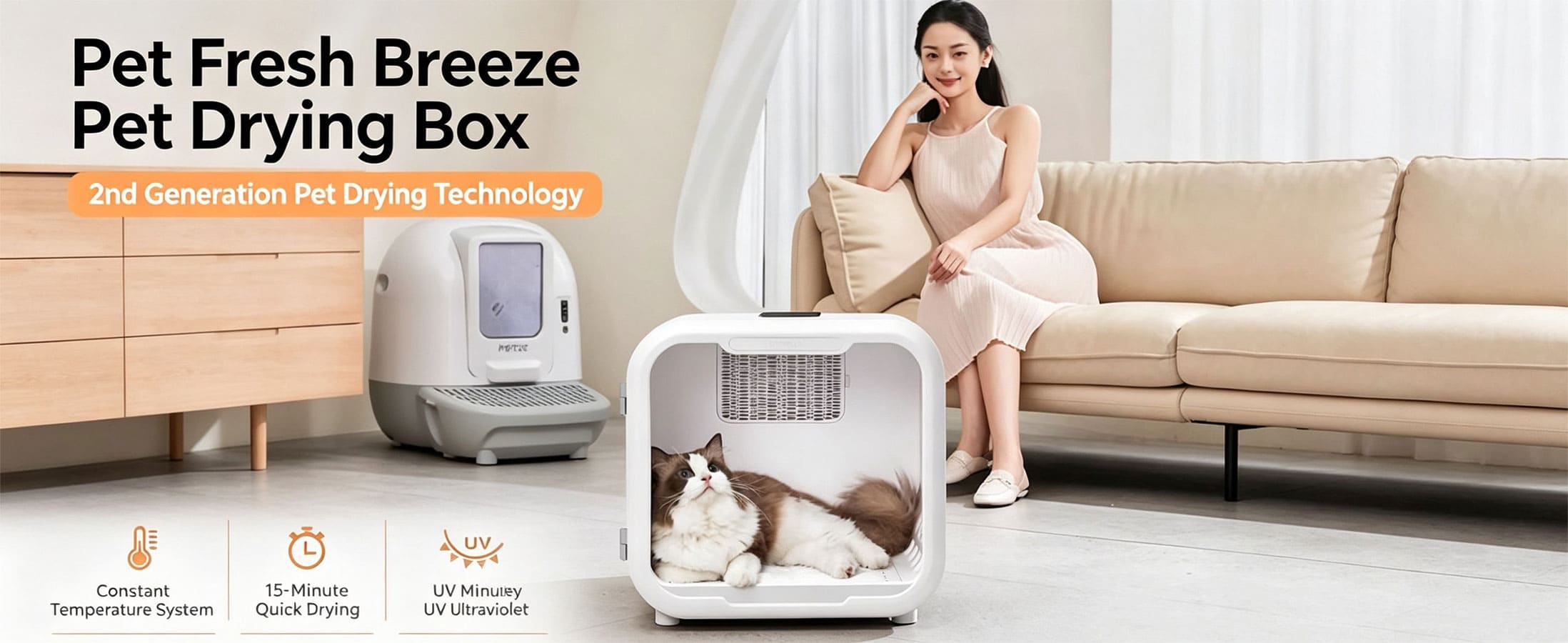
The pet drying box is one of the fastest-growing small appliance categories, and one of the easiest to get wrong. The concept is simple: enclose the pet, blow warm air, dry the coat hands-free. The execution is where products succeed or fail, and the failure mode is not cosmetic. A drying box that overheats, suffocates, or terrifies the animal is not a product defect. It is a liability event.
For distributors, the procurement approach to drying boxes must be different from other pet appliances. Features are not about convenience or connectivity. They are about safety engineering. The product highlights that matter are the ones that keep the pet alive, comfortable, and calm.
Highlight 1: Patented Fresh Air Ventilation, Not Just Recirculation
The most important specification on a drying box is the air exchange rate. A box that recirculates hot air without fresh intake creates a suffocation risk and a heat stress risk. The leading product in this category uses a patented fresh air ventilation system that performs 15 air exchanges per minute, with hundreds of venting holes supporting continuous fresh air intake and hot air exhaust.
This is the feature that separates a legitimate product from a dangerous one. Procurement must demand the air exchange specification in writing, and should verify it through a simple smoke test: introduce a small amount of visible vapor into the box and measure how quickly it clears. A box that takes minutes to clear is not adequately ventilated.
Highlight 2: Smart Temperature Control with Precision and Redundancy
Traditional hair dryers overheat. That is an accepted risk when the device is hand-held and the operator can feel the temperature. In a drying box, the pet is enclosed and cannot escape. Temperature control is therefore not a comfort feature; it is a safety requirement.
The best products offer adjustable temperature from ambient up to 104°F (40°C), with precision of ±1°C and multiple safety checks per second. The control system should include redundant sensors and automatic shutoff if any sensor reads outside the safe range. Procurement should request the control logic documentation and verify that the shutoff is hardware-based, not solely software-dependent.
Highlight 3: 360° Bottom-Up Airflow for Even Drying
Uneven drying is the most common consumer complaint about drying boxes. If the belly, paws, and armpits remain damp, the owner must finish the job manually, defeating the purpose of the product. The best designs use a patented air path and a motor in the 350W range to deliver constant bottom-up airflow that reaches the areas gravity and top-down air miss.
For procurement, the verification method is a wet-pet trial. A standardized test using a damp towel or a cooperative pet, with timed checks of moisture at multiple body locations, will reveal whether the airflow path is genuinely 360° or merely marketed as such.
Highlight 4: Ultra-Quiet Operation
Noise is the primary cause of pet stress in drying boxes. A pet that panics in the box is at risk of injury and will not be returned to the box for a second use. The leading product operates at approximately 40dB, which is comparable to a quiet library conversation. This is achieved through motor selection, vibration isolation, and airflow path design.
Procurement should measure noise at the actual operating distance, not at the motor housing. A specification that quotes dBA without stating the measurement distance is incomplete. Request the test protocol along with the result.
Highlight 5: Dual-Use as a Pet Bed
The best drying boxes solve a secondary problem: storage. A single-purpose appliance that occupies floor space and is used once a week is a hard sell. Products that convert to a cozy pet bed when the drying function is not in use justify their footprint and their price. Detachable doors allow the owner to interact with the pet during drying and remove the doors entirely for bed mode.
This dual-use design is a genuine product highlight, not a gimmick. It increases utilization frequency, which increases perceived value and reduces the likelihood of the product being relegated to a closet.
Procurement Recommendation
The drying box category is not for every distributor. The product liability exposure is higher than in most small appliances, and the engineering requirements are more demanding. But the category also has less price competition and stronger margins than commodity pet accessories. The right approach is to source only from suppliers who can document the safety features above with test reports and design specifications. A supplier who talks about “quiet operation” and “even drying” without providing air exchange rates and temperature control precision is not a supplier for this category.