
We source water fountains, feeders, and drying boxes. On the surface, these products have little in common. One circulates water, one dispenses kibble, one blows warm air. But when we evaluate suppliers across all three categories, a pattern emerges. The products that perform best in the field, generate the fewest returns, and earn the highest review scores share a consistent feature philosophy. Understanding that philosophy is more useful than memorizing specifications, because it tells procurement what to look for even when the specific product is new.
Shared Feature 1: Fail-Safe Design
Every premium product in our portfolio has a fail-safe behavior built into its core function. The water fountain shuts off automatically when water levels are low, protecting the pump from dry running and the pet from drinking from an empty basin. The feeder continues dispensing on battery backup when the power fails, so the pet is fed regardless of household infrastructure. The drying box shuts down if temperature sensors detect an anomaly, regardless of what the software is doing.
Fail-safe design is not a feature the consumer sees on the box. It is a feature they experience as the absence of disaster. For procurement, the question is not “does the product have this feature?” but “what happens when the primary system fails?” A supplier that cannot answer that question has not thought about failure modes, and a supplier that has not thought about failure modes will eventually produce products that fail.
Shared Feature 2: Materials That Contact the Pet Are Specified and Documented
The water fountain uses 304 stainless steel for the drinking tray and BPA-free ABS for the reservoir. The feeder uses a stainless steel bowl with a non-stick coating and a hopper material that meets food-contact standards. The drying box uses materials that do not off-gas at operating temperature.
The common thread is that the pet-contact surfaces are specified by grade, not by generic description. “Stainless steel” is not a specification. “304 stainless steel” is. “Food-grade plastic” is not a specification. “BPA-free ABS” is. Procurement should require material declarations for every pet-contact surface and should be skeptical of suppliers who describe materials in marketing language rather than technical terms.
Shared Feature 3: Cleaning Is Designed In, Not Added On
The fountain that cannot be disassembled becomes a biofilm farm. The feeder whose hopper cannot be removed retains stale food and attracts pests. The drying box with inaccessible interior surfaces accumulates hair and odor. In every category, the products that earn the best long-term reviews are the ones that are easy to clean thoroughly.
The premium standard is tool-free disassembly of all pet-contact and water/food-contact components, with dishwasher-safe ratings for the parts that can tolerate it. This is an engineering decision made early in the design process, not a feature that can be added in production. A supplier that did not design for cleaning cannot be asked to add it later.
Shared Feature 4: The App (When Present) Serves a Clear Purpose
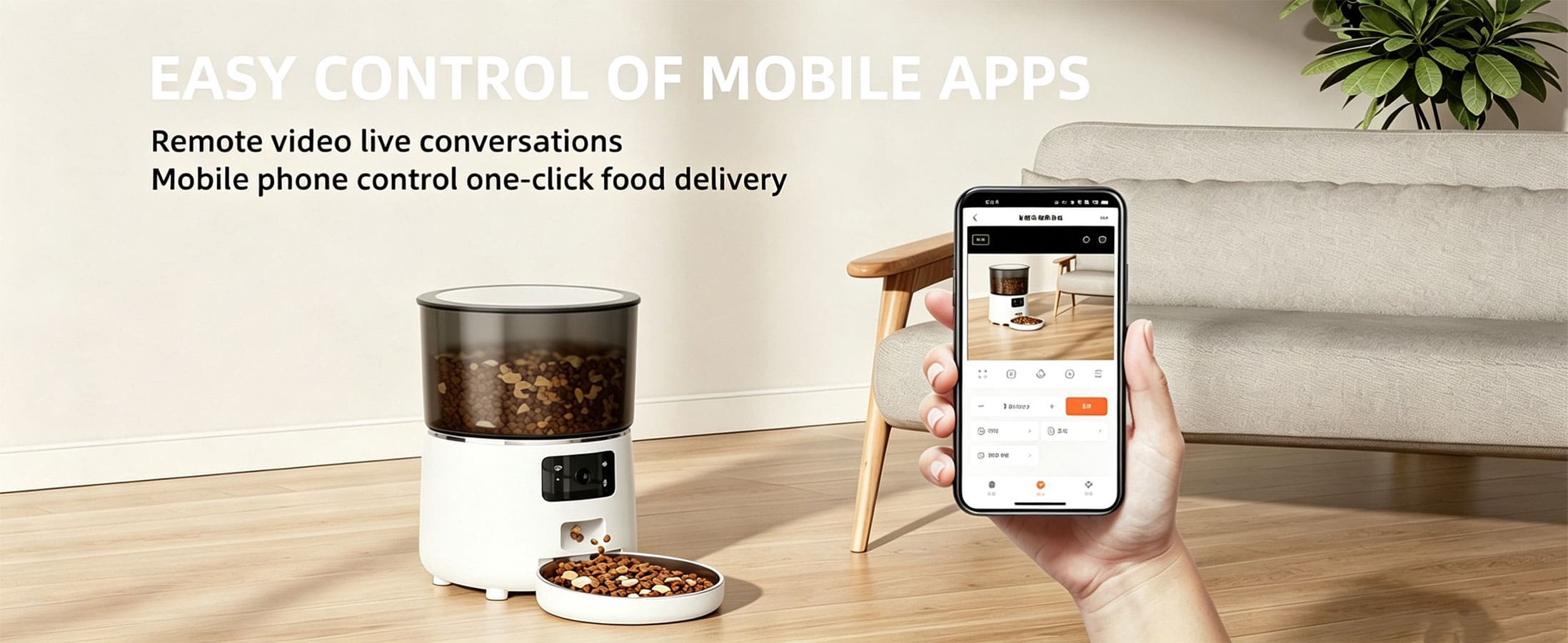
Connected features are not inherently valuable. A Bluetooth connection that does nothing except display a battery percentage is a cost without a benefit. The products in our portfolio that include connectivity use it for one of two purposes: health monitoring or status assurance. The fountain tracks drinking frequency and duration, because water intake is a meaningful health signal. The feeder sends alerts for low food, power loss, or dispensing failures, because those are the events that matter to a remote owner.
Procurement should ask a simple question about any connected feature: “What decision does this help the user make?” If the answer is vague, the feature is probably not worth the BOM cost and the support burden.
Shared Feature 5: Quiet Operation as a Baseline
Noise is the most underrated specification in pet appliances. A fountain that gurgles or hums disrupts sleep. A feeder that clatters at 6 a.m. wakes the household. A drying box that roars terrifies the animal. The premium products in every category treat quiet operation as a baseline requirement, not a premium upgrade.
The fountain operates at 26dB. The drying box operates at 40dB. These numbers are meaningful only when compared to the alternatives, which are often significantly louder. Procurement should request noise measurements at the operating distance and compare them across suppliers. A supplier that has not measured noise has not optimized for it.
Procurement Recommendation
The common features above are not a checklist for any single product. They are a lens for evaluating any new product in the pet appliance space. When a supplier presents a new SKU, ask: What happens when it fails? Are the pet-contact materials specified by grade? Can it be fully cleaned? Does the app help the user decide something? Is it quiet enough to live with? The answers will tell you more about the product’s long-term performance than any feature list.